Sunday, March 5, 2017

Coming to Conclusions

This post is part 5 of a series on changing PhD programs, chronicling my transition from the Colorado School of Mines to whatever comes next!

So I realize the last time I wrote about my PhD search was in.... October.... but in my defense, the intervening months included:
  • Being sent on my first airborne gravity survey
    • Totally not glamorous, involved a lot of time on a laptop in a hotel in central California
  • Completing PhD applications
    • Which made me really miss the days where the only way to send your transcript was a hard copy by mail, because every school I applied to had some subtly different form they wanted for the transcripts, and most of those subtle differences were only discovered in a blind panic at the last minute
  • The winter holidays
    • In which various people close to me made it clear that I was to take a break, or else
  • Starting an application for a NASA Earth and Space Sciences Fellowship, and ending up starting a business instead
    • Those two are only loosely related, as it turns out
  • 40 hours of training for a new volunteering position
    • I'm not very good at this whole "taking a break" thing
  • Visiting one school!
    • Liked the school, not the 6 AM flight I had to take to get there...

So now that we're all caught up.... in my last post I stated I had narrowed things down to 4 schools, and then in a footnote you may or may not have read (or remembered), I hinted that that had gone down to 3 schools.  Reason being, funding for studying in the UK is somewhat difficult if you're a student from the US.  The professor in question seemed eager to have a student, and had really interesting research and the funding to do it.  The catch being that this funding would not cover a US student... So, for me, that meant either a) doing a 3-year PhD abroad with no stipend to support living expenses or b) getting lucky with scholarships.

Regarding option a), going without funding for living expenses for a graduate degree in the sciences is very uncommon, at least for the Earth Sciences.  I've heard of people doing it for a two year master's (while working part-time), or maybe while finishing up a PhD, but definitely not for a full PhD.  So if a professor is suggesting that you work for them without funding.... be very, very cautious about that situation.  In my case, I didn't feel like anything untoward was going on - the professor was very upfront about how the funding worked, and funding is often tricky where international students are concerned.  Since the funding situation had been made clear to me, I decided to see what options I had to find funding on my own.

Option b) (finding scholarships) proved to be riskier than I felt comfortable with.  It turns out there just weren't that many scholarships I was eligible for in my situation.  The only way I could figure out how to do it was getting the Fulbright scholarship, which was a very small number of slots for only one year of funding, and then getting lucky enough to get a second scholarship geared towards women getting science graduate degrees.  I realized I could very likely wind up in a situation where I could be left in the lurch funding-wise halfway through my degree.

Since I was pretty happy with my other three options, and the logistics of heading off to the UK were a bit daunting even without the funding debacle, I decided to leave my study-abroad ambitions for another phase of my life.  Perhaps a post-doc someday...

While we're on the topic of funding, I mentioned going after a NASA Earth and Space Sciences Fellowship (NESSF).  I eventually ended up not going through with this, for a few good reasons.  The first reason, which had been bugging me from the start of the process, is that while the NESSF goes with the student who wins it, I still didn't know where I was going to end up for school.  I was working with one professor on ideas, and after a while the thought that I might brainstorm with this professor, get the NESSF, and then go to a different school after all that, just didn't sit well with me.  If there's one thing I've learned about myself in the past few years, it's that I really value being honest with people, and I also value my own flexibility.  Doing the NESSF now meant going against one or both of those values.

The second reason... I really don't know remote sensing well enough to write a proposal I would feel comfortable submitting!  As part of trying to prepare the NESSF proposal, I looked over a few previously successful proposals.  Reading through those proposals, and then trying to sit down and answer similar questions with my own proposal, I quickly realized I just didn't have the background to do a good proposal - right now.  I know some people might read this and think "oh, this is just imposter syndrome!  She's actually qualified and she's selling herself short."  That's a fair point, as imposter syndrome is generally considered to be a A Thing for women in male-dominated fields*.  However, as an argument in favor of my assessment of my background, I will point out that all of the successful proposals I read included one thing I most definitely did not have - preliminary results!  I don't care how much confidence you have - you can't wish preliminary results into being!  In the end, I decided that, rather than rush through a proposal I knew wouldn't be very good, I would much rather wait a year and submit a proposal I could be proud of.  Not that this was an easy decision to come to - I really, really, do not like backing down on anything!

*For the counter-argument, read this very interesting article about how over-emphasis on imposter syndrome can end up distracting from the very real structural problems women in STEM fields face.  But I digress.

So!  Back to the thing I'm more excited about right now, which is figuring out how to be a volcanologist again!  In the period between sending in my applications and starting to hear back from schools, I was pretty intensely anxious about getting in anywhere*.  As with the first time I applied to a PhD program, I didn't have much of a backup plan if I didn't get in anywhere.  I knew I could probably figure something out, but what, where, how soon?  Would I just be perpetually stuck doing stuff I wasn't really all that crazy about?

*Work didn't help with this - dealing with a seemingly never-ending stream of gravity meters finding new and interesting ways to break on a daily basis hasn't exactly been conducive to functional insanity.

Thankfully, thankfully, the first offer of admission came in late January*, and for the first time in a long time I really, genuinely, started to feel hope about the future.  Over the past month I've become slowly more and more convinced that I will be able to be a volcanologist again, something I wasn't really letting myself believe before.  So if you see me starting off into the distance grinning like a crazy person...  now you know why!

*So I guess the period of intense anxiety wasn't actually that long (since I sent in the last applications around the 5th of January) although it sure felt like it!  

I'm a happy volcano!
This is a real photo of the lava lake on Pu`u O`o, the site of the current eruption on Kilauea's East Rift Zone.


Last week I flew out to visit one of the schools I had applied to, and found out while I was there that they had accepted me - so now I have not one but two ways to be a volcanologist again!  Even better, I genuinely liked what I saw and experienced of the town, the campus, the department, and most especially the professor.  It really helped add to my feeling of happy anticipation about the future to know I genuinely liked at least one of the options.

I know it's not always an option for everyone looking at grad school, but if you can, I highly recommend visiting the campus before you make your decision.  You're going to spend at least four years there - you want to make sure you'll like living there, for one thing!  I also think it's important to meet people in person, to give all those little subconscious processes that we collectively refer to as our "gut" to work their magic.  This is particularly important where the potential adviser is concerned, since so much of your academic success is dependent on this one person.  It's also good to get a sense of your fellow students, too, as they will be your support system through all the ups and downs of grad school!

In two weeks, I'll be visiting the other two schools I applied to, and then I'll have to make my decision by April 15th.  Based on what I've seen so far, I anticipate this being a very hard decision, for all the right reasons.  It's a decision I'm looking forward to, because for the first time in a few years, rather than being a decision about avoiding further damage, this will be a decision about moving forward to improve my life.

Unless I decide to write another post about that final decision, I think this will be the last post in this series.  I'd like to leave you with a nice pretty numbered list of important things to consider when you're either contemplating switching PhD programs or starting your search for the first time:

  1. It is OK to do a PhD.  It is also OK to change your PhD if things aren't working.  It's also OK to leave a PhD and start on a new path.  Bottom line: it's your life, don't suffer - or avoid joy! - because someone else thinks you should.
  2. Know why you are doing what you are doing.   Not so you can have a good excuse handy for well-meaning family and friends, but so that you can better understand what you need to look for.
  3. Pay attention to what gets you excited.  This may mean deviating from what you've done for a while - and that's cool!  If you already knew everything, there'd be no point in going for a PhD.
  4. PEOPLE ARE IMPORTANT.  Talk to potential advisers - directly.  Know who you'll be working with, and if you can work with them!  Skype is great, in-person meetings even better, if possible.  Also talk to current and former grad students!
  5. Funding is important!  Generally speaking, don't go off and do research for someone who can't/won't pay you.  In a science graduate degree, your work will support your adviser's work, and this needs to be compensated.  Definitely for a 4+ year long PhD!
  6. PEOPLE ARE IMPORTANT.  This is really really really important, so it's going on this list twice!

Thank you for reading my ramblings - I hope some of them were useful to some of you.  If you're going through a similar transition, I wish you the best of luck - it can be pretty scary to jump ship, but I now finally believe that it can be worth it!

This is the (currently) final post in the "Leaving for Lava" series about changing PhD programs.  Should you wish to peruse further, here are the previous posts in this series:

Thursday, October 20, 2016

Black Lives Matter

We interrupt our highly-irregularly scheduled series on PhD switching to bring you: a rant.

\begin{rant}

While driving home from work today, I heard this story on the radio about a Colorado Public Radio host, who is a black woman, who got stopped by a police officer (white), after a 911 call about a "black man wearing black carrying a rifle".   Thankfully, this story ended well.  As soon as the officer realized she was in fact carrying a bag of golf clubs, he immediately apologized and essentially nothing happened.  In all respects, I believe both parties handled the situation spectacularly well, and for that I commend them both.  I encourage you to read or listen to the story in full.

But what really got me about this story, is that it all took place in the neighborhood where I grew up.  In the story, they play the audio of the 911 call.  I know telling race from voice is definitely not a sure fire thing, but the woman on the call sounds white.  And I know the area of Denver where I grew up is pretty dang white.  I knew personally all of three black students at my high school, and two of them were half Asian*!

*Although they are by and large perceived as "black" by most people, the way things go.

And when I learned that the woman in the story is actually CPR's host of All Things Considered, Jo Ann Allen, I got this horrible sick feeling in my stomach.  I don't know this woman personally, but I hear her voice almost every day.  And I feel terrible that she had an experience in which the thought "I could die" crossed her mind - in my neighborhood, because of my people.  Because she is black.

I wasn't the one who made that call, but I still feel like I need to apologize, because the woman who did could easily have been someone I know, the mother of one of my friends growing up, someone I could run into a store while on the way to my parents' house.  I'd imagine she didn't make the call out of any blatantly racist intentions - she saw what she thought was a black man with a rifle, and she reported it.  The thing is, there are so few black people in my neighborhood that most of us almost never meet black people in our daily lives, we mostly only see black people on the news as criminals, or as poor people in inner city slums.  People, in short, to be afraid of.

And I'm not exempting myself from this.  I get the same dang gut reaction of fear and nervousness when I meet black people, unless they're one of the few I already know, because I have so little experience and so much implicit bias from everything I've seen and and not seen growing up, fighting with my progressive values, that I just can't act natural.  I am awkward, I probably give people weird looks, and I hate it.  I hate that I instinctively treat them differently.

But I'm not the one who has to worry about getting shot, because someone's gut classification of me was "threatening".  Jo Ann Allen is highly educated, and provides a valuable service for our community.  She's "made it", is arguably doing everything right, and still she has to face this risk.  Because of people like me.

It makes me so mad - people like Jo Ann Allen, people like my friends, people like the undergrad I ran into at AGU or the high school student at my church, they can work hard, they can smash stereotypes about what they're supposed to be "capable" of and more tangible barriers like poverty and single parents... and it can all end with one police interaction gone wrong, from one white person who just assumes a black person is a threat.  And it happens all too often.

I'm also angry that because of our segregated existence that there aren't more black people in my world of science.  Through science, I've met people from all over the world, but I can still only name a handful of black people I know personally.  And it makes me sad.  What is science missing because we're missing these people?  How many young black men and women have never had the chance to pursue a degree in geology because they got shot before they could make it to school?  Or, less dramatic but no less sinister, they were pushed off that path by barrier after barrier after barrier until it just wasn't worth it anymore.

I have all the markers of privilege in this world except gender.  I can easily just turn off the radio after a story like this and never give a second thought - because I can do that.  I'm not the one at risk in this scenario.  And that fact really sickens me.  Those of us with these markers of privilege - we can't do that anymore.  We are losing too many people because we just look the other way.

I'll be quite honest - I don't really know what the answer is.  I've tried to read up on this - read articles written by black authors giving advice to those such as me.  One thing that comes up time and time again is simply educating yourself.  Reading about incidents like the one that just happened to Jo Ann Allen.  Reading the stories and experiences of black people all over the world, coming to understand them as individual humans with often very different struggles from the ones I face.  I also try to donate to organizations that support black students in STEM, and reach out to the what few young black students I am so lucky to encounter in what I really hope is an encouraging and not creepy-white-savior kind of way.  I don't know if any of this helps much.  I feel like my demographic has a lot to answer for, we have a lot of work to do to fix this.  On behalf of myself and my race, I am sorry.

Black Lives Matter.

\end{rant}

Thursday, October 6, 2016

Knowledgeably Narrowing

This post is part 4 of a series on changing PhD programs, chronicling my transition from the Colorado School of Mines to whatever comes next!

Right, so summer exploded on me, as summer has been apt to do the past few years, so I haven't had time to do much beyond fight the most proximal fire for the past few months.  I'm still getting used to this adult thing where summer isn't a time when things slow down - on the contrary, they seem to speed up.....

So, since I started writing the last post in.... May..... I've run off on several trips, GOTTEN MY FIRST PAPER PUBLISHED IN A PEER REVIEWED JOURNAL*, and I've somehow managed to track down and make contact with all the professors on my short list.

*I'm not excited about this AT ALL.

I PUBLISHED!!!!


In general, if you're applying to grad school, it's a very good idea to make contact with the professor you're planning on working with first.  This is how you find out some very basic, essential information, such as does this person even have funding for you in the first place, and when the heck do you apply*.  It's also a way to get an up to date summary of their current  research directions and get a first read of them as a person**.

*This is turning out to be a non-trivial question for one of the universities I'm applying to....
*Step 1: Did they actually answer the email??

It's also, crucially, often the first time they will get to read you as a person.  A few of the professors I contacted had met me before, but for the majority it was essentially today's equivalent of a cold-call.  Among the ones I had met,  the meetings were often brief or in passing - I had never worked with any of them before.  So it was very important to me that I present myself as well as I could in this first contact.

The process of drafting this first-contact email was actually pretty involved, and I think I worked on it off and on for about a month.  The email had the same basic structure for each professor:

  1. Hi, my name is THIS, and I want to study volcano deformation
  2. I want to study with you because you did THIS WORK and it's awesome to me because THIS
  3. Here's a brief summary of my science life before now
  4. Here's what I'm doing now
  5. This is why I left my first PhD
  6. Here's some ideas I'm interested in researching now
  7. I might help fund myself through THIS

Given that I left my first PhD, it knew it was really important to present my story in the best way I could - I wanted to make it absolutely clear that I had not left because it got too hard or because I was lazy, because that simply wasn't true!  I wanted to make it clear that I had left out of a love for research that unfortunately just couldn't be realized at my former institution.

I also wanted to counter-balance the leaving part with my own qualifications.  This part was both easy and hard to write - easy, because it was all stuff I knew well (i.e., my own life), and hard, because I really don't like bragging!*

*I've found wine can help with this while writing scholarship applications

Both because of my queasiness with talking up my skills and qualifications and my desire to get my story right, I had several people in my inner circle read over my email.  Their comments helped me to avoid embarrassing typos and make sure my wording was clear.  Most importantly, they reassured me that I wasn't going over the line into excessive self-aggrandizement - in fact, they almost always told me to include more about myself, with stronger language!

The other part I got helpful feedback on related to talking about the work of the professors I was contacting.  Many in my inner circle strongly advised me to demonstrate in my email that I was thoroughly familiar with the professors' work.  The process of researching their work in further depth was helpful not only for writing the email, but for increasing my own understanding of what they did, and how I might fit into that work.

It took forever to get those emails out, but it was worth it.  A couple of the professors I was able to rule out pretty quickly.  One simply said straight-up that he didn't have funding - I was very glad for his honesty!  Another I finally quietly gave up on after a series of emails that just went nowhere.  I would attempt to get a productive conversation going about his current research, and I kept getting back one or two sentence responses that never really answered my questions.  I don't know definitively if this was a sideways attempt to dissuade me, but regardless, I quickly realized that if I couldn't find a way to communicate with this person by email, this was not a promising sign for working with him in person!

The other exchanges I had, however, were far more encouraging.  A few I did have to send a polite follow-up email to after I had received no response for about a month - in all cases, the reason was that they were out of town for vacations or fieldwork.  These professors, once I did receive a response, were more than happy to tell me about their current research opportunities, and transparent about their current funding situation.  I had been a bit worried about the length of my initial contact email, but one responded with an email even longer than mine!

Of these professors with whom I had positive email contact, I've now been able to meet them either in person or via Skype.  I've found these interactions very reassuring.  There were a few professors who came off as slightly cold in email exchanges, but via Skype I found them to be very warm, quick to smile, and easy to joke with.  This is actually really important to me - I tend to want to make jokes about everything, all the time, so if someone is too serious they're going to be difficult for me to work with closely, because I'll constantly be worried that I'm being too silly.  I also suspect that having a good sense of humor can be a good indication of flexibility in a personality.

The meetings were also really useful for having a real-time discussion about the research opportunities, the school culture, and the PhD program structure.  For me, it is always so much easier to have a discussion in real time than be tangled up in knots trying to have a discussion over email, where I have to figure out how to phrase things clearly and succinctly, and more importantly, find time to do this.  Each conversation gave me a pretty good sense about what the research would be, and what life in the department might be like.

One thing I've also been doing is reaching out to current or former students of these researchers.  While I did ask most of the professors to tell me a bit about their advising style, I of course know that source is slightly biased!  I also knew that if there was anything not-quite-right going on, I'd be likely to hear it from the student.  In a few cases, I knew personally some of the current and former students (or knew people who knew them), but in others I just asked the professors if they wouldn't mind me reaching out.  One professor even suggested I contact his students even before I asked!  In general, I've received pretty rave reviews of the four finalist professors, which has been really good to hear.

So now from 20 odd professors, I'm down to 4.  All have research that makes parts of my brain jump up and down with excitement, seem to be decent human beings, and either have funding in line or a clear-eyed assessment of where funding will likely come from.  This phase of the process has been more than me simply figuring out where to apply - it's really felt like I've been interviewing these professors for the job of advising me!  I realize that sounds full of hubris, but the reality is, a PhD-student relationship really should go both ways - we have something to gain from each other, and if I can't be sure they'll be able to be a good adviser to me, that's not a relationship I should pursue.

However, now the other side of the process begins - the application phase!  Now's my chance to prove that I am and will be a thoroughly awesome student.  More on this in the next post - which will probably appear in mid-October, after I've survived the Fulbright application!*

*EDIT - I'm actually not applying for the Fulbright.... for reasons which I shall reveal in THE NEXT POST!  The suspense is just killing you, is it not??

Previous posts in this series:
  1. Leaving for Lava
  2. Redesigning my Research
  3. Professorial Processing

Tuesday, September 6, 2016

Professorial Processing

This post is part 3 of a series on changing PhD programs, chronicling my transition from the Colorado School of Mines to whatever comes next!

This post is a little out of date, I started it in May and then summer exploded on me.  I'll have a slightly more up-to-date post in the next week or so, I hope I hope I hope.....

Now that I've given you a sense of what kind of research I've decided to go for, I'll give you a taste of my process for tracking down professors with whom I would like to do that research.  Over the past month or so I've been brainstorming, bugging colleagues and friends, and scanning listservs and other online resources to amass a list of potential professors I might like to work with.  I've been determining additions to the list based on some mindfulness about how I react to the descriptions of a professor's work, what little I can glean about their person, and the feel of the institution.

I'm not working with much data for these impressions, since the large majority of these professors are people I have yet to meet in person.  As a scientist who's supposed to be cooly analytical, it also bugs me to have to rely so much on online impressions of a person.  However, recent experience has taught me trust my instincts a bit more, and there is some amount of research to back this up.  It's not the best evidence, but it's what I have at the moment.

And because I'm a scientist, I of course have to find good ways of analyzing and sorting my (highly subjective) data.  I am a self-avowed spreadsheet addict.  So, naturally, I have created a spreadsheet and rating system for the PhD search.  Part of this spreadsheet serves as simple data collection.  I have fields for professor, institution, their research, and what research I might do with them.  That last field is important - I of course want to make sure the professor does cool research, but it has be cool research I can see myself working on.  Location is also important to me, as it will take a certain amount of activation energy to get me to move from a place as awesome as Colorado*.

*Where it was snowing on May 1st when I started writing this post...

The second part of the spreadsheet is my tool for making sense of all the information by applying my subjective ratings.  I rate based on the person of the professor, my impression of the institution, howI feel about the research, and what I think of the location.  I used a scale from -2 to +2, with -2 being "really not psyched" and +2 being "oh HECK yes!!".  I use only integers to try to keep the subjectivity in control.

The results have been useful for making sense of my giant data collection spreadsheet, although I'm having to stop myself from trying to code up a clustering algorithm.  When I plot my ratings as a bar chart sorted from lowest score to highest (below), I can break up my "professors of interest" into about 4 groups: definitely interesting (7+), pretty interesting (5-6), meh (4), and probably not (3 and below).

Professor names concealed so I and them can maintain some modicum of privacy.


Now rather than trying to track down over 20 people, I've only got about 8 professors at three different universities to seriously pursue.  If a significant fraction of those 8 professors don't work out for some reason, I can go back to my "meh" and "probably not" categories and re-evaluate.  At the end of the process, I hope to have 3 or 4 programs to apply to, with things narrowed down to only one or two professors at each of those programs.  I confess that the chart above is actually out of date - I got it down to about 10 professors when I decided to focus on deformation alone.  I'm still working with my ratings system, though, as it's still helpful to have a way of prioritizing my options.

What's next?  First, lots of discussion with people close to me, both personally and professionally.  The goal of these discussions will be to help me narrow down the list further to the professors I actually want to contact.  Then, I get to do the very scary job of actually reaching out to some of these professors, which will likely narrow things even further.  I'll write a bit about these discussions, and about reaching out to the professors, in a later post.  That is, if I can ever get myself to stop fiddling with my spreadsheets...

Previous posts in this series:
  1. Leaving for Lava
  2. Redesigning my Research
Next posts in this series:

Wednesday, May 11, 2016

Redesigning my Research

This post is part 2 of a series on changing PhD programs, chronicling my transition from the Colorado School of Mines to whatever comes next!

In my last post, I laid out the reasons behind my recent decision to leave my PhD at the Colorado School of Mines in search of a PhD where I can do research that will truly make my heart sing.  As promised, this post will be an update on this transition.

Now that I've made the decision to leave, now I have to make the equally hard, and in some ways scarier, decision about where to go.  Scarier, because I want to get it right this time!  It's hard to admit to myself, but I realize now I probably didn't do enough research and soul-searching when I chose the PhD program at Mines.  On the other hand, to be fair to myself, I legitimately didn't realize just how strong an aversion I would feel to working on oil and gas problems, and how intensely I would miss volcanology.  However, that is all in the past now, so this time I'm determined to get it right, or at least to make a more informed decision.

A large part of this is figuring out just exactly what part of "real data science" excites me, because in the world of academia just saying "I want to go poke volcanoes!" isn't nearly specific enough.  Some things are easy - I know that geochemistry, for instance, makes me want to cry in a dark corner with a blanket over my head.  So some sort of geophysics.... but what??  I've realized that my old formula of "gravity+volcanology" is far too narrow a subfield to help me in my current quest.  I'd also like to add to my toolbox of volcanology, and there are some pretty neat tools out there I could play with.

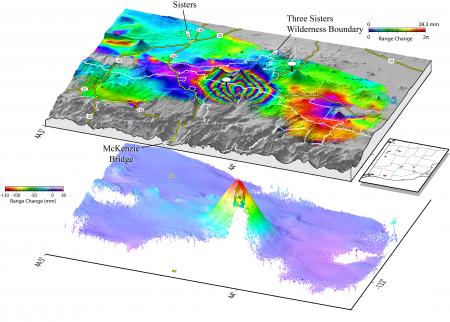
The first tool that caught my imagination was deformation.  When I say deformation, I mean measuring  small changes in the position of the earth's surface, by either ground or space-based methods.  A really famous example is the bulge that formed on the north side of Mt. St. Helens prior to its 1980 eruption.  More recently, scientists used InSAR to track inflation of the Three Sisters volcano in Oregon.

Recent deformation on Three Sisters volcano in Oregon, measured with InSAR.  Pretty pretty rainbows.

\begin{volcanology_geek_time}

Here's a really cool video of Mt. Etna in Italy deforming!  Mt. Etna is one of my all-time favorite volcanoes because the Italian volcanologists have done all sorts of cool gravity work on the volcano.  Many of the papers written on the gravity measurements at Etna were among the first real scientific papers I read as an undergrad, so Etna holds a special place in my volcano heart.


\end{volcanology_geek_time} 

Deformation is a natural complement to gravity, a potential field I already know and love.  The measured value of gravity is strongly dependent on the elevation.  Because of this dependence, we need really precise position measurements when doing a time-lapse gravity survey in places like volcanoes where we expect significant change in elevation.

Deformation and gravity work well together because while deformation can do a really good job of giving the "where" and "how much" of volcanic activity, gravity gives insight on the "what".  I'm pretty well versed in gravity at this point, so I'm thinking it might be cool to see what I can do with deformation, maybe even mix the two together with joint inversion shenanigans.

In addition, there's the tempting fact that there's a lot more places in the world where you can do deformation work.  Currently, satellite based gravity measurements don't have a high enough resolution to be useful for volcanology.  However, InSAR satellite measurements can measure centimeter scale deformation on volcanoes.  So, suddenly, there's a lot more volcanoes I can poke at now....

Going a bit further away from gravity, I've also explored seismology a bit.  In a way, I've already been doing seismology-lite, in working with continuous gravity data.  Many of the techniques I use for looking at this gravity data are drawn from seismology, and it's one of my favorite parts of my job.

Because it's me and I like weird stuff, I'm interested in weird seismology.  This means weird sources (landslides, glaciers, etc.) and weird signals (low frequency, etc.).  This is definitely a field I know much less about, and I'm a little hesitant about getting into seismology, simply because it's so big a field.  So much so that the average person generally doesn't seem to know that geophysics beyond seismology even exists, grrr.  I do admit to a certain feeling that I am betraying "my people" by considering seismology.....

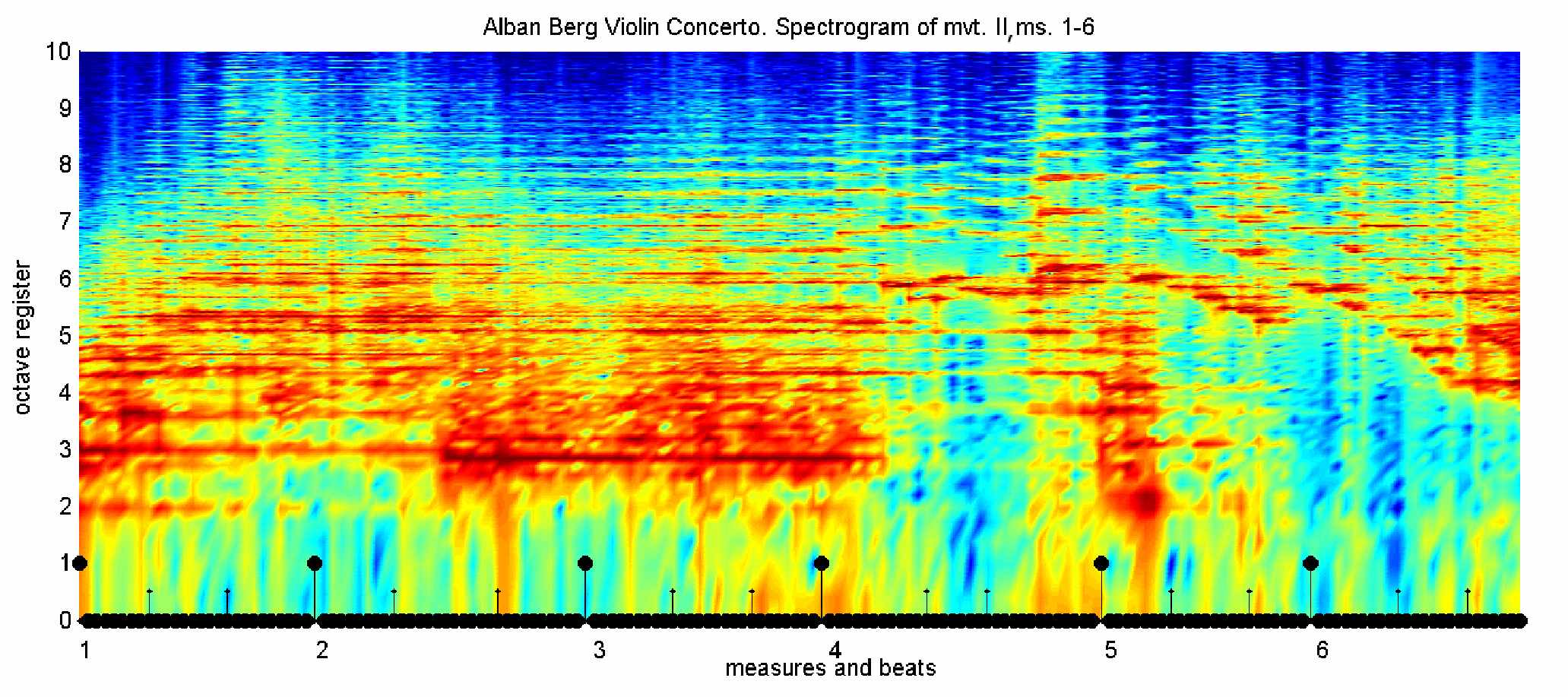
Nonetheless, I have to admit the seismologists have some really cool toys.  I've always been fascinated by spectrograms, for instance.  And after working in gravity, where the sparsity of most data sets (in academia, anyway) generally precludes some of the fancier processing wizardry, data collected at frequencies greater that 1 Hz is down-right drool-worthy.  Throwing math at data to get answers has always been one of my favorite parts of physics, and there's just so much data in seismology!

Music scores of the future?

Seismology has been pretty tempting, but after internal reflection and a productive conversation with my master's adviser, I've finally decided to focus solely on deformation.  Deformation is a smaller field than seismology, and I've observed that I really thrive in the niche or frontier regions of science.  This was actually one of my frustrations with research in exploration geophysics - I felt like all the interesting, fundamental problems had already been solved.  I feel similarly with seismology.  Seismology is such a huge field that I know it would be harder to carve out my little part of it, which is why I was targeting my search for the kinds of "weird" seismology that are more fringe and thus more me.  Deformation is not really a new field, but it is certainly much smaller than seismology, so I suspect that will make it easier for me to find an unexplored corner to go get lost in.

There's also the issue of time.  While I would not call my two years at Mines wasted, I'm not overly eager to spend much beyond 4 years on my next PhD attempt.  This would definitely be a risk if I were to jump into seismology, about which I know only the fringes.  By contrast, I'm much more familiar with deformation, and more importantly, I've already been able to dream up a few research ideas.  This will be important for hitting the ground running for PhD Round 2!

It's actually been pretty fun figuring out my research path, and incredibly freeing.  After two years of subconsciously trying to fit my research interests into a mold that just wouldn't fit, now I've been able to let my thoughts roam free and settle where they will.  Now my daydreams aren't just daydreams - they're research ideas and plans for my future, and that is pretty awesome.

Next up.... will you be my adviser?  The search is on!

Previous post: Leaving for Lava

Next posts in this series:

Monday, April 18, 2016

Leaving for Lava

Watch out, volcanology.  The lava lady is BACK.

I'm assuming what I'll be announcing here will be common knowledge to you, the reader, as I'm assuming 99.9999% of my audience here is friends on Facebook, aside from those 8 people in Ukraine.  But for those of you who missed my announcement (or who live in Ukraine), I have decided that I will not be continuing my PhD at the Colorado School of Mines, and will instead be looking for another school at which to complete my PhD.

I wanted to write here about my experiences in making this decision (and the coming transition period) because when I finally found myself ready to move on, I found a whole lot of information about leaving a PhD entirely, and nothing about simply moving to a different PhD program.  So while I am by no means a professional guidance counselor type and am learning this "on the job", as it were, I thought I might chronicle my experiences here in this more public forum so that my story might serve as a resource for others facing this decision and transition.

So, why am I leaving?

There are many factors, but the most important is that I finally came to realize that I just wasn't all that interested in the research I was doing, and the kind of research the department specializes in, generally speaking.  The Mines geophysics department does all kinds of crazy cool things with geophysics methodology, working pure freaking magic with data like you wouldn't believe!  But the catch, for me at least, is that all this focus on methodology means that there's less focus on the geological problems we're trying to solve with geophysics.  And eventually, it dawned on me, that's a really essential part of why I love geophysics!  While I will salivate over some Fourier finesse or an insightful inversion, what really puts a fire in my heart is the answer at the end of the geophysical analysis, or, in many cases, the next question.  Is that a magma chamber I see?  Is it connected to this other one? WHY???  In the end, I want to be the person asking those questions, and using geophysics as my magic wand to help solve them.

I came to this realization in stages.  First, it was the culture shock of going from 6 years living in the very pro-environment Pacific Northwest to a very industry focused school, and trying very hard to get interested and excited about industry issues.... and just not.  It felt increasingly like I was one of millions trying to carve out a tiny slice of a very huge and mostly-eaten pie.

Then, it was noticing where my brain went when I would zone out in classes.  Everything ended up in volcanology.  Every new method I heard about, I wanted to apply to some problem in volcanology.  I just could not stop thinking about volcanoes, and lava, and magma, and volatiles, and pressure, and... you get the picture.  Industry problems were just not something I could see myself working on.  It would have to be something related to volcanology.

I tried figuring out a PhD thesis topic that would involve research that I could easily apply to volcanology, as an attempt to placate my volcano-obsessed brain.  However, it was quickly obvious my ideas weren't really going anywhere, and it still felt like something was missing.

Still, even though I was feeling increasingly uneasy about whether I was in the right place, I stayed on.  Part of this was the heavy course load I endured for the first three terms.  I wanted to see if my fourth term, during which I was taking only two very minimal courses and finally focusing on research, would be an improvement.  I didn't want to leave just because it was hard.  More importantly, at that point I had only "push" factors - factors suggesting I was in the wrong place, but nothing to suggest there might be a better place elsewhere.  Without something pulling me away, I couldn't be sure that my thoughts about leaving were simply stress from the PhD that might eventually pass as I adjusted.

Finally, just before spring break, two events happened that gave me my "pull" factors.

On Thursday that week, the speaker for our department seminar happened to be a professor who specialized in InSAR, and had done work on volcano deformation.  This particular scientist was someone who had actually been on my radar for some time, as she had also worked with gravity in the past, and I had actually briefly spoken with her about doing a master's several years prior. Before the talk, out of curiosity, I started looking up some of her more recent papers, and was instantly intrigued.  Here was someone studying the earth system I was clearly addicted to, and she used really amazing math and geophysics to reach some really interesting conclusions!

With these thoughts swirling in the back of my mind, the next morning I gave a Q&A session for a group of students about being a volcanologist.  The Q&A session the following morning was another eye-opener.  In talking to the students about the work I had done in volcanology, I realized how much I missed it, how much I missed doing work that was that...well... awesome.  Doing something I really felt passionate about.

I started thinking about which of the department seminars really had me on the edge of my seat.  And when I thought about it, it was always the talks where the focus was on solving some problem in the natural world, be it analyzing the seismic signals of glaciers, detecting volcano inflation, or simulating erosion due to landslides.  It wasn't the talks that were more in line with what the department specialized in, the talks about industry problems, or fine-tuning seismic imaging, or improving inversion algorithms.

I had been operating under the thought that, hey, I'll do this PhD at an industry-focused school, learn all the cool tools people use in the industry, and then sneak back into volcanology with my new-found geophysical goodies.  But I started thinking, seriously, was it worth it to me to do a full PhD on stuff that wasn't really what I wanted to do, at the end of the day?  Did it make sense to do a PhD I wasn't really passionate about, in the hope that at the end, I'd be able to break back into a field I would have been out of for likely over 5 years?

What the department seminar from the InSAR specialist had shown me was that I could achieve both of my goals at once - I could do really cool fun math intensive geophysics, AND study volcanoes.  Suddenly, whereas before I had only push factors, the nagging feeling that I didn't belong, not being very excited about the research opportunities available to me, now I had my pull factor, something enticing me to think again about what I might do beyond Mines.

With both push and pull factors, I made my decision - Mines was simply not the right place.  It was a bittersweet realization.  Bitter, because I am not the sort of person to leave things half done, and I knew I would genuinely miss the amazing people at Mines.  Sweet, because it was such a relief to have finally made the decision, and to finally allow myself to think about science that really fired me up!

Of course, then I had to figure out how to break the news to everyone, most importantly, my advisers. I ended up writing several drafts of what I would say or send in an email, and had people close to me review my writing.  I wanted to explain my decision clearly without seeming dismissive of Mines, because even though I had decided to leave, I didn't think any less of Mines, it just wasn't the right place for me.

I ended up delivering my decision to my advisers by email, not my first choice (the circumstances ended up forcing my hand), but at least that way I was able to choose exactly what I wanted to say.  I immediately followed this with an email to my friends at Mines, followed by a Facebook post, because I was very worried about what people would think, and I wanted everyone to know my decision, and my reasons, from me first, and not on the grapevine where my reasons might get distorted.

 I was very afraid of the condemnation of my peers - afraid people would think I had just given up, that things had gotten too hard and I had failed.  I was astonished by the incredibly positive response I got instead!  I heard from a few friends who had made similar decisions, and found themselves very much the better for it.  Several of my friends applauded me for having the strength to follow my dreams.  Many of them even used the word "brave".

And I guess I did have to be brave.  I was definitely playing all the pump-up music I had when I was driving up to Mines to deliver the news to my advisers*, and I was pretty dang scared to come back to campus the next week**.  But at the same time there was such relief from feeling that I was no longer lying to myself or the people around me that it made the fear conquerable.

*Who ended up being out of the office when I got there, hence delivering the news by email - there were some deadlines coming up that kind of forced my hand that way.

**Which ended up being delayed by a very nasty resurgent case of strep throat, as Murphy's Law is still in full control of the universe.

I of course don't know if there are people saying nasty things behind my back - there probably are, humans are humans.  I learned a valuable lesson, though, and that is that people in our society do actually respect the idea of someone following their dreams.  I know we like to pass around optimistic cartoons and such praising the idea of pursuing goals outside the beaten track, but I kind of assumed that this was just a thing we say to be nice, and that what people really think is different.  Again, don't know if people are saying one thing and thinking another, but the sheer volume and consistency of the positive response I received kind of makes me think it might be real.  Every now and then, humans can surprise us - for the better.

So I'll offer this advice to anyone contemplating a similar move:

  1. Think about your push and pull factors.  Why do you want to leave?  Is there a somewhere you can see yourself leaving to?
  2. Take care to communicate your intentions clearly and civilly.  Be honest, but be nice - the world can be a pretty small place, and it's always better to keep allies than to make enemies.
  3. Give people the benefit of the doubt - the people in your life will understand and support you, just give them the chance.
So what am I doing now?  Well, I'm finishing up my term at Mines, and when I'm done with that I'll be working full time at my currently part time job, while I figure out PhD Take 2.  At the moment I've got a huge spreadsheet going (because I LOVE me some spreadsheets) with potential new advisers, their institutions, their research, etc. and plans to make some sort of spectacularly complicated rating system that I'll probably end up ignoring in the end.  I'll attempt to post updates here, and talk a little bit more about the process of figuring out what comes next.

In the meantime, I'll be dealing with the flood of repressed volcano love, which may end up being channeled into some slightly less dark lyrics for this very awesome attempt at a volcano-themed version of one of my favorite songs:


Currently questioning the wisdom of ending a post about not burning bridges with a song about burning, well, everything.... oh well.

Next posts:
      2. Redesigning my Research
      3. Professorial Processing
      4. Knowledgeably Narrowing
      5. Coming to Conclusions

Wednesday, December 9, 2015

Statement of Purpose

The book of Face now has this wonderful feature where it will throw up your old posts from years past.  I was apparently somewhat loopy in December of 2010, that day features a lip-dub I made of Aretha Franklin's "Think" in which I yell at my physics textbook, and the following "draft" I wrote of my statement of purpose for applying to grad school for my master's.  Enjoy.

I tried writing an essay, I really did....

You should give me money because I are really smart. I works in a lab and sorts rocks and stuff so people can tell how volcanoes exploded. And sometimes I shake them for hours in big sieves. Not the volcanoes, the rocks. And last summer I got really wet and muddy and dug lots of holes so people could listen to really long earthquakes. And I saw lots of slugs and my boots didn’t dry off for three weeks, so I think I definitely deserve some sort of compensation for that, don’t you think? I think so. Anyway, I also do lots of stuff with the geology club, like teaching middle schoolers and stuff, and I want to use geology to help people and stuff. You know, like hazards and stuff. I want to run around on volcanoes and put gravity meters on them, and then tell people when to run away. I might even get the government to pay me for it if I work for the USGS. Otherwise I’ll have to sneak out with the gravity meters at night and be that crazy lady in the woods. But see, people never listen to the crazy lady in the woods, so I probably should get a graduate degree and a job so people will listen to me. Oh and history is really cool. I like history too. Because you can look at history and tell how people were stupid in the past and figure out how to try to keep them from being quite as stupid in the future, but then future people will look back on us and think we were really stupid, so it’s probably a moot point anyway. But it’s still fun to learn about, because it’s like story time, and if you just do science and don’t factor in human stupidity nothing works very well. So you have to have both, you know? You have to study old rocks AND old people. Works better that way. So, see, I’m studying both those things, and if I get really good at it and you give me money I’ll study more, and then maybe I can help keep at least some people from killing themselves through stupidity. Although there are always those few that Darwin gets, but, you know, that’s life! You go along, and one day.....poof! Poof, I say! So, in conclusion, you should give me money. A few thousand would be nice. Just a thought.

Tuesday, December 8, 2015

Muslims and Mexicans

I'm writing this here because my thoughts on the subject won't fit in a Facebook status.  Perhaps you've heard the news, or perhaps you haven't, that Señor Trump has recently announced his plan to bar Muslims from entering the United States.  I've been hearing and watching the stream of vitriol from this particular candidate for the past months with growing alarm.  I have a good deal of friends who could and might already be affected by the venom this viper spews, and it is for them I write this.

First of all, Mexicans, or Latin Americans in general.  I have a Mexican-born friend who had to leave school suddenly, with no explanation, and I only found out later it was for immigration reasons.  She is not an illegal immigrant.  She was getting a graduate degree, working towards making herself a citizen of great value.  And yet she had to put that all on hold so she could remain legal. About half of the students in my department are from Central or South America.  I have several friends in Mexico, students at the university I visited as a guest lecturer for a week, who are wonderful people, who helped me function with my limited Spanish and awed me with their prowess and skills.  What would they face if they came to my country?  What about the girl I met in the bus station in Mexico,  when I was alone near midnight in a bus station in Guadalajara, I was the only white girl in the station, and I couldn't understand the announcements in the bus terminal, and she immediately took me under her wing, making sure I got on the right bus and got to my destination safely?  Were our places reversed, would she receive the same welcome in my country?  Or would she be treated like a criminal?  Sadly, I think the latter is more accurate.

See, what scares me most is not so much Trump - he is one man spewing crazy.  It is these people who keep supporting him in the polls.  Or even the people who don't support him all the way, but perhaps are quietly grateful for his crazy because it legitimizes their racism and prejudice by contrast.

These people put my friends in danger.  I am legitimately scared for some of my friends, especially my Muslim friends, now.  Or heck, even those who look vaguely Muslim.  Because white people are stupid and can't tell the difference, as the tragic events in Wisconsin show.

Muslims are my friends, they are my teachers, they are my colleagues, they are my neighbors.  And I am scared for them.  I am scared that my friends I met in Canada will never be able to visit me in the United States without fear.  I am scared that some crazy white person could storm one of my classes at Mines, which can easily be half Middle Eastern students.  I am afraid for my friends who are Arab Christians, because white crazy is just going to assume that they are Muslim too.  I am afraid for the Iraqi Christian family at my church, because for the same reason they too are at risk, they who are already refugees, and came to my country as safe haven.  I pray that will not turn into a sick irony.

It was a conversation with one of my dear Muslim friends that got me going back to church after a long hiatus.  Talking with her about her religion made me realize how important mine was to me.   This same friend remembered me on the worst birthday of my life, bringing me a cupcake and a song when I had chained myself to my desk to work after yet another emotional breakdown over my thesis.  And it was an Iranian Muslim friend who quietly told me at a department party that there are still some in world who view America as a good place, an example to the world.  It makes me sick that there are so many in my country who would exclude him unconditionally.  An Arab Christian is helping me survive one of my hardest courses to date now.  Will he be in danger if he doesn't openly wear a cross? I was overjoyed to run into a Turkish friend, who I don't even know if he's Muslim or not, at a scientific conference.  He's also now at risk whenever he comes into my country.

I have heard from some of these friends of extra searches at airports, the difficulties of getting an American visa to merely visit family.  And now we've got this idiot candidate rousing up all the white crazies like the one who recently shot up a Planned Parenthood in Colorado Springs.

I am terrified for my friends.  I am terrified that it's only a matter of time before their rights start getting restricted, before I start hearing of them getting killed for wearing hijab or being in a mosque or looking Arab.  Oh wait, that's already happened, there were the three students in North Carolina.

And no, I am not going to debate the "there are Muslim terrorists!" and "Muslim governments do terrible awful things!" part right now.  I am not talking about terrorists.  I am not talking about governments.  I am talking about people, my people, people I love and respect and admire and care about very, very deeply.

So please, if you as a white/Christian/American person hear someone ranting about "those damn Muslims", shut them down.  Maybe even say something to law enforcement, if you think it's warranted.

Keep my people safe.

Wednesday, May 13, 2015

A Fading Fear of Faith

I WANT THIS ON MY CAR. NOW.

So I wanted to write about church.  Yup, I go to one.  That seemed like a way scarier statement to make when I lived on the West Coast, than now, where a lecture on campus given by a priest was very nearly standing room only... that was weird for me!  Anyway, I think because I did my undergrad and master's on the West Coast, where things are just a *bit* more liberal in general, I kind of have this skewed vision of how science and religion get along, which may or may not conform to reality.  It actually seems pretty normal at Mines to be religious, at least moderately so.  We don't seem to attract any traveling fire-and-brimstone preachers, anyway.  I kind of miss them... It's way too quiet on this campus without an atheist vs. traveling preacher stand-off now and then!

I've probably just completely undermined my point here, but I wanted to write about the whole I-go-to-church thing because I do think there is a pervasive perception that science and religion aren't compatible.  I think that's true in some cases, for some strains of religious belief, but not for mine.  I think if you believe that the Bible (or other holy text of your choice) is literal, unfailing truth...yeah, science is going to be a bit problematic for you.  That whole "the Earth is 6000 years old thing".... going to cause some issues.

I'm a progressive United Methodist.  I grew up in this church (the "progressive" part came more recently), and I was lucky enough to not grow up in churches that were particularly prone to fire and brimstone.  No one in the church ever told me I couldn't be a scientist!  To be honest, the churches I grew up in were pretty mum about anything controversial.  Oh, there were the usual calls to slow down, spend time with God, be nice to people, but nothing you could really argue with.  I often wishes the churches I grew up in could have been just a little more feisty about...something.  Anything.

The messages I heard, that you couldn't be a scientist and be religious, always came from outside, usually from the world of science.  I'd often hear statements like "Oh, those Christians and their young-Earth ideas"... and I'd always kind of bristle because no church I'd ever attended had preached such things!  But I can definitely understand where science might be just a bit skeptical of faith, Christianity in general.  Though it is now centuries past, the Church's treatment of Galileo still rankles.  And let's not even start on evolution.  Oh dear.  But it's also just a bit hard to swallow, how can a person of faith profess to believe outlandish things like a virgin birth, water from rocks*, and people coming back from the dead, and then still do good science, which rests on the foundation that things must be able to be tested and proven?

*Well, okay, I can see that one being some divinely-inspired geological know-how on Moses's part....

My personal answer to this is that my faith is not just a checklist of things I do and don't believe.  I'll be 100% honest, I have a really hard time wrapping my head around the physical reality of the virgin birth, or Jesus' resurrection, two events that are pretty dang essential to my faith!  I do believe in God, though, that I'm pretty sure of.  For me, the belief in God is the sense of a presence that I simply know to be there.   Even when I realize I'm probably never going to accept the resurrection as physical, unassailable fact, I know I can't shake the feeling that there is a God.  I've come to accept that there are certain elements of my faith that I'll probably never be able to come to terms with, but this doesn't mean I can't have a faith.  I am also lucky enough to have found a church here that makes it very clear that there is no litmus test of faith required to be a part of the church - I am allowed and encouraged to think, reason, and disagree.

Speaking of my church brings me to discuss the real reason I'm often nervous to share with people that I'm Christian and that I attend church.  The church I currently attend is a Reconciling United Methodist Church, meaning that this is a United Methodist Church that is actively working to fully include LGBTQ+* persons in the life of the church.  This means they are welcome to church, to communion, to being married in the church, to everything that any straight, cis-gendered person person would be able to access in the church.

*Please forgive me if I use any incorrect terminology for the rest of this article.  It is not my intent to harm by using language that has become hurtful over time, but I'm not always as on top of things as I should be.  If I have used any language that is now considered hurtful or offensive, I welcome any corrections in the comments.

This, for me, is huge.  I'm cis-gendered and straight, by the way.  But for a very long time, I was reluctant to openly identify as Christian because, as far as I knew, all Christians were supposed to be against homosexuality or anything of that sort because it was a sin.  This seemingly institutionalized hatred, to me, always seemed far more of a sin than being born gay or lesbian, or being trans.  This also seemed to fly in the face of how my parents had taught me to treat people.  So, for a long time, it seemed to me that to be Christian was a form of sin in itself, because to be Christian required to me to exclude certain persons in a way that seemed very out of touch with what I had thought Christ had taught.  I have friends and family who are gay or lesbian, and the last thing I wanted was for them to feel unwelcome, excluded, dirty, because of my faith!

So for most of undergrad I stayed away from Christianity, although I missed the hymns and ceremony of the church services that had been such a consistent part of my childhood.  I also never quite gave up on God - I stopped really thinking about Him much for a while, but I never quite lost the feeling that He was there.

I'm having a hard time remembering when this started to change.  I think some time around the beginning of grad school, I began to hear bits now and then that a different kind of Christianity existed.  I had a few friends from high school who were openly Christian, and I think they may have posted a few things on Facebook suggesting a different interpretation of the relationship between homosexuality and Christianity.  I think the watershed moment was when I ran across the documentary "Fish Out of Water".  I was quite literally bawling when I came to the end of the film, in fact, I'm tearing up now having watched only the trailer!  The film documents the struggles of Christian gays and lesbians, but most crucially, offers alternative interpretations of the Biblical texts used to condemn homosexuality in the church, and documents the works of churches already working to fully include gays in lesbians in the church, including allowing them to marry the people they love.  This film showed me a way out.

The way that was shut to me now seemed open again.  I could be Christian and not be evil!  It may sound ridiculous to some to say such a thing, but before I learned about this new progressive Christianity it really did seem to me that to be Christian was to be forced to be evil, was to be required to be unwelcoming and hurtful.  Now I had learned that I could practice my faith, and actually follow the teachings of Christ, not in shunning or trying to reform "sinners", but rather in welcoming those who had been previously marginalized and shut out.

Around the same time, I encountered a fellow graduate student in Earth sciences who let slip that he was actually an Evangelical Christian.  Wait, what?? That was possible?  To be Christian and a scientist?  An Earth scientist??? That was allowed??  Suddenly more Christians in our department appeared from the woodwork, and we actually had a small Bible study going, still the only one I've ever attended in my life.  It was awesome - we had three Evangelicals, three Catholics, a Serbian Orthodox, and me, the random United Methodist.  I was absolutely terrified to bring my Bible to campus, and oh, the walk down the hall to the little room where we met, trying to hide the little black book all the way, oh that was awful.  I was quite literally in a cold sweat the whole time.

But it was worth it - for the first time, I was finally able to ask questions, and even if they often weren't answered, we at least had discussion, questioning, talk, the kind of conversation I'd never had when I was growing up.  I'm sure that was at least partly an age thing, but I think it was also the church I went to  - as a youth, Christianity seemed to be presented as more about rock and roll church and singing praise songs than discussing faith and learning theology.  I was always the weird one, so I never felt included or confident enough to ask questions.  Yet now, I had a small community of faithful just as weird as me, who weren't afraid of my questions, and didn't force their own faiths down my throat, as I'm (still) always afraid of when meeting other Christians.  They shared their views, and I mine, and we had long, winding discussions, and it was wonderful.

I eventually found a church in Vancouver, where I was living at the time.  It ending up a rather  hilarious situation... Because I had never felt comfortable in modern churches, I purposely sought out a more traditional church.  Having an organ was a requirement!  The first church I visited in my area, I think one person talked to me.  The second church I visited was in a completely different part of town, but I ended up staying there, because immediately at the end of the service I had about 5 people coming over to talk to me!  In hindsight, this was probably mostly because I was a 23 year old who had just showed up in a church where the average age was about 65....

That was a wonderful church, though.  I loved the old-style hymns they played, I was recruited into the choir my second week there by the choir director who had the most amazing dry wit, and the sermons were both progressive and mentally stimulating.  Best of all though, I found what I had never experienced before in a church - a community.  Even though I was about 40 years younger than most of the people at the church, I felt included in a way I had never before.  Despite the older demographic, I was also in a welcoming and accepting church - the second pastor who came while I was there was openly gay, and the head of the United Church at that time was also openly gay.  The people at the church loved the pastor, and didn't hide it.  They also loved me, and didn't hide that either!

When I moved back to Denver for grad school round two, I knew I needed to find a church like the one I had left behind in Vancouver.  By this time I had heard about the Reconciling movement in the United Methodist Church, so I knew this was where I needed to search.  My search algorithm was pretty simple - Reconciling, and has an organ.

I found what I was looking for at Christ Church United Methodist.  This is actually the only church I ever visited in Denver, but I've never felt an urge to look elsewhere.  Just as with my church in Canada, I was recognized as new on my first visit and welcomed by several people.  And, oh, they had a real pipe organ! And they played it, too!  I also got a good read on the culture of the church my first Sunday - it was Super Bowl Sunday, and all the choir had made orange stoles to go with their blue robes, and I think there may have been confetti...  The sermons were intellectually engaging and morally stimulating, engaging with Biblical texts in ways I had never heard before.  I think it was on my second or third visit that the pastor reminded the congregation that he would be performing same-sex marriages, in defiance of the official doctrine of the United Methodist Church.  This is the church I'll be joining, officially, on Sunday.

These amazing women have actually gotten married something like 7 times now, as marriage laws have changed over time in the different places they've lived.  I think this photo is likely #6, at my church!

I'm getting a bit better about being scared to announce that I'm Christian, because I'm much more comfortable about what that means now.  It doesn't mean I sweep under the rug all the pain that has been caused by my religion both now and in the past - I acknowledge it, and it grieves me deeply.  I do not deny that to call myself Christian connects me with countless acts of hate and cruelty across the ages.  What I know now is that it is my duty as a Christian to undo what I can of that pain, by trying to live out what Christianity should be - welcoming, loving, and affirming of all peoples.  I need to witness to the reality that my faith can be welcoming to those that have been marginalized in the past, that we can do our best to listen and make better.

Claiming my identity as a Christian also gives me that much more purpose in my work as a scientist.  Because I am Christian, I am charged to make the work that I have been called to do the very best I can.  This means I must be ethical and honest in my work, and give accurate results that will be good and useful for others.  It means I must support my fellow scientists.  It means that as a female scientist, I must stay the course so that I can hold open the door so that others like me can follow, and keep it open for others for whom it is now only barely opening.  Science isn't just something I do because I love it and it pays a decent salary, it's something I do because I feel called it.

And oh my goodness, science is where I have so many of my religious experiences!  Fourier series, GCV, wavelets, inversion, VOLCANOES, agh, to think that we have a world where these things work!  Isn't that amazing???

....*Hem*, okay reigning in the slightly crazy religious fanatic here.  Although I suppose raving about God in the context of Fourier series is slightly better than eternal damnation?

I hope I haven't come across as trying to convert anyone with this post.  That wasn't the intention.  I simply wanted to share something I'm really excited about, and if it's something that makes you excited too, great!  We can go babble about the holiness of inversion together.  But more seriously, I wanted to share my story because I've realized in this past year how important stories can be.  Stories give us options, stories give us understanding, insight onto new perspectives we might not have encountered before.  Before I started to hear stories about progressive Christianity, I despaired of ever being able to practice my faith with integrity again - now I don't.  More recently, before I heard the life stories of some of the amazing women in my field, I feared getting stuck on an oil and gas track for life - now I don't.  So I hope this little outburst of mine perhaps helps someone out there realize - there are options.  There are alternatives.  There are many stories to be told.

Tuesday, February 24, 2015

Feelings on Feminism

I actually wrote this about a month or so ago, but am posting it now because the (male) professor in my "Intro to Research Ethics" class (not actually as dry as it sounds) praised the fact that I had written about how being a woman in a traditionally male-dominated field is actually a pretty big driving force propelling me forward in geophysics.  I felt pretty intensely uncomfortable about being "revealed" publicly as a feminist, even in a positive sense.  The conflicting feelings I felt today - wanting to stand behind what I wrote, but feeling a great deal of trepidation over being "outed" as a feminist, reminded me of this post I wrote some weeks ago.  Also the fact that I actually had something of a night off, for once... 

The few weeks during which there was an uproar over a certain shirt were a bit jarring for me.  Mostly, because I was just shocked at the denial that the shirt was sexist*, in such tones as to suggest that this denial was simply common sense. I’m not going to jump into the argument over whether or not the shirt was sexist, because I’ve already done that, and that’s part of why I felt the need to write this.  I feel the need to explain a bit about why I keep posting all those articles, why I don’t post some other articles, why I am feminist, and why I felt a bit queasy about writing that last phrase.  

*The context in which the shirt was worn being a HUGE part of this

First, what I post and what I don’t post.  I would like to point out that the article I posted about the blankety-blank shirt was actually an attempt to move on from the issue.  The article I posted described how a female scientist saw the shirt, and did her own remake by photo-shopping the visages of notable female scientists onto the shirt, transforming the shirt from a symbol of latent sexism and microagression to a celebration of women’s contributions to science.  This is the kind of article I like to post, because there are few things that turn me off more than an angry diatribe*.  Mostly, though, I feel there are plenty of articles floating around about all the things that are wrong, and not enough about what to do about it.  I may be disadvantaged in terms of my gender, but this is very much not the case where race is concerned.  From my white perspective, I know how frustrating it is to be told always what NOT to do, and be always be wondering what I could possibly do to help and not hinder.  So when I find articles that offer helpful instruction, or information about methods that work to lessen the obstacles that women face in today’s society, those are the ones that I try to share. 

*although sometimes those are very much needed.

I also delight in sharing encouraging stories, when I can, about awesome women doing awesome things.  The article I posted related to the @#$@#$ shirt falls in this category.  One of my qualms about many of the feminist articles I read is the overall tone of doom and gloom (more on this later), and so I try to alleviate this when I can, as much for my own sake as anyone else’s.

Of course, I’m human, so I will occasionally go on a brief (say, two or three) article posting spree.  I actually just took a spin through my Facebok feed from the last nine months or so, and was somewhat confused to find very few posts on feminism.  So either I don’t post as much as I think I do or Facebook is hiding things.  Not really sure.  ANYWAY, most of the articles/videos/etc that I avoid posting are the gut-reaction ones, you know, the pictures that have some poignant picture and some sassy one phrase statement.  I may get a kick out of them sometimes, but I generally avoid sharing them because I don’t think they help.  I think they give those of us “in the feminist club” a thing to chuckle about, and give those “outside the club” another thing to get pissed off at.  So nothing is really accomplished.  I’d much rather help people see a reason to listen, and make them think.  Unfortunately, this strategy means posting a bunch of long articles I’m pretty sure not a lot of people read. 

So why care?  Well, for one, selfish interests.  I’m a woman in a male dominated field.  For most of the time I’ve worked there, my office has had one woman in the building – me.  We’ve recently hired a full time female geophysicist*, so now that’s increased to all of two.  Out of about twenty five or so humans in the whole building.  I will say right now that any bad experiences I’ve had related to my gender have been very, very mild, mostly just loneliness and a sense of having to be extra awesome to adequately represent my gender.  But there is something really off about these gender ratios!  Other selfish interest – I haven’t faced much gender discrimination or violence yet, but that doesn’t mean I won’t sometime in the future.  I’ve already had the experience of having a stalker for several years,  I regularly have to strategically avoid certain men at social dance events, and our advisors had to specifically tell the women in our research group to be aware of bad situations prior to our sponsors' meeting.**  I’ve had friends who have faced worse – leaving their careers because of hostile work environments, abuse, rape.

*Who did the survey planning for a 4-D gravity survey I may end up studying, fan girl swoon.

**I will say I’m very glad they were open about this, instead of sweeping it under the rug as a shameful thing that was only the women’s fault.  This shows awareness and integrity, and I salute them for it.

It is hard to un-see a thing once it is seen.  I have read so many articles on the challenges women face, particularly in science, that it is hard now not to automatically notice gender ratios at a conference, see who is presented as “successful” in an article*, notice who professors will praise and who they only mention, notice how all the founding scientists of geophysics are men.  I get tired of noticing all the extra things I have to think about as a female – is it safe to walk down this street?  Is this guy talking to me a threat or just friendly?  Do I need to stop dancing with this guy before he gets “ideas”?  

*All men, surprise. Should really have saved that article link, sorry.

It all gets me just a bit riled up.  It’s hard for me, sometimes, to imagine a reality in which I wouldn’t have to think about these things as a matter of daily life – the reality of a white male.  He only has to think about these things if he decides to, for me, it’s my reality all the time.  And I know it is so, so much worse for other women.  I’ve been rather ridiculously lucky to have the worse thing to happen to me be a few minor stalking episodes.  I can’t imagine having to deal with the trauma of something worse, AND being the only one around who will speak up about the societal systems that make such things common.  So because I have been relatively unscathed, I feel it’s my duty to speak up, as someone who’s “made it” so far.

And now for why I cringe at calling myself “feminist”.  Part of it’s a personality quirk.  I’m extremely contrarian by nature, so I instinctively hate associating myself with a label or a group.  For the same reason I cringe at calling myself “environmentalist”, even though I probably for all intents and purposes am*.  But on a deeper level, I worry about what all this does to me, on both an internal and external level.  I don’t deny that feminism needs to be a thing.  There’s too much stupid stuff in the world that just needs to change.  However, it gets exhausting being angry so much.  It is hard to un-see things, and harder to know that if I want to call them out I’m going to have to fight an uphill battle against very entrenched mindsets.  The anger is insidious, and more than once I have felt the danger of it poisoning friendships and relationships.  I am not a vindictive person, and I do not like finding I am angry at someone.  But because I am a faulty human being, I often find it hard to separate a person from their views, when those view run counter to something that is so very important to me, both as an issue and as a reality of my life. 

*which is just FUN when the research you love is funded by the extraction industries….

I also worry how my feminist views affect how people see me.  I wonder if employers, who is my field are pretty likely to be older white males, are going to find out about my feminist views and associations and think, oh, here is a white hot flaming feminist, she won’t do good work in our mostly male company. She is emotional and irrational, we don’t want her.  I wonder how my friends see me – do they see me as fiery emotional feminist firebrand on fire?  It is so important to me that people be able to talk to me, and the idea that people might not talk to me for fear of being attacked distresses me, all the more so because I know what that feels like in my identity as a White Upper-Middle Class Anglo Saxon Protestant American.  I don’t want to inflict that on my friends!  

Nonetheless, there are the people who quietly tell me that reading some article I posted empowered them, or helped them realize a difficult situation wasn’t actually just them being weak.  I’ve had older women tell me on more than one occasion to keep fighting, to not let slide the gains they made in their generation.  And that is very heartening.  But I am a pacifist at heart, and I find it hard to come to terms with the fact that sometimes conflict is necessary in order to fix things that need fixing.

So why am I still feministing?  Well, I’m a very stubborn optimist, and a lover of history.  At the SEG, we had a panel of prominent women in geophysics speak about their experiences in geophysics.  Something I have been thinking about a lot lately, when I am feeling overwhelmed by all the stupid resistance one can get for daring even to criticize a @%^% shirt:  would these women, one of whom was the first ever female PhD in EM (electromagnetism) and another who still remains the only female president of the SEG, have believed that one day I’d be in a geophysics research group that was slightly over 50% female?  Would they have believed that I would make it to the second half of my master’s before I realized, oh wait a minute, some people think I’m not supposed to do this?  I’d like to think they would have.  So I’m going to stubbornly believe that today’s trolls will be tomorrow’s history lessons, that the idea of not having equal numbers of women and men at an engineering school will be something for my children to gasp and giggle at.  That someday, I won’t have to explain to a man why a shirt is sexist, and I won’t even see the shirt in the first place.  I’m hoping that some day I’ll have some really hair-raising stories, and that they will be just that – stories, and no longer reality.